Saturday, January 7, 2023

7 Ways to Walk in Step with the Holy Spirit: How to Live a Victorious Christian Life

One of the most important things about the Christian life is that we understand it's a lifelong journey.  It starts the moment we receive salvation through Jesus Christ, but it doesn't end there.  That is just the beginning. A wise believer ought to see their Christian walk as a journey, one day at a time, with Jesus the Lord. 

Many believers fall short in their need for endurance and perseverance (Hebrews 10:36) and end up drifting away from the message of truth (Hebrews 2:1). If salvation is not followed up by discipleship, it may become nothing more than an emotional moment that fades as quickly as it came. Don't let that be you.  Recognize that you will have to be very intentional in your walk with God.  

Jesus never said it would be easy, but He did promise to be with us in the struggles. His yoke is easy and His burden is light (Matthew 11:30), yet the way is narrow (Matthew 7:13-14). The message is open to anyone (John 3:16-17) but not all who say to Jesus "Lord, Lord" will inherit eternal life, but only those who do the will of the Father in Heaven (Matthew 7:21-23).

D.L. Moody the famous evangelist said that the secret to success in the Christian life is understanding that Christians are to live in lockstep with the guiding of the Holy Spirit (Galatians 5:25). We learn as Christians to be practically guided on a daily basis by the leading of the Holy Spirit (Romans 8:14).  The Holy Spirit who lives in us, guides the direction of our life. We check our decisions by the leading of the Holy Spirit through prayer and the study of the word, and He practically guides our every choice to be along the path God has for us. 

As we follow God's leading the path of our life becomes more and more true to God's purposes. The Holy Spirit fills us with joy and peace in those moments. When we resist His leading and go astray, the Holy Spirit convicts us and guides us back to the right path. When we go astray, we submit to God again, repent of our sins, and we come again to Him, and he restores us. 

This is the work of the Holy Spirit in us. But, the work of the Holy Spirit in us does not mean we do not do our part in walking faithfully with Jesus. The Spirit will lead our lives, and our part is to obey and order our lives around the God, the practice of the fellowship with believers, and other instructions we're given from the word of God about how to live a victorious Christian life. 

One of the best things you can do is to order your life by developing a detailed schedule for each week.  Make sure you're attending church services locally at least once a week.  Why?  This helps you stay connected to the gospel message, and receive spiritual energy for each week ahead.  That's why God commands his people to come together for fellowship (Hebrews 10:25).

Secondly, make sure you are attending a weekly Bible study or small group (2 Tim 3:16, John 8:31). The bear minimum for a Christian believer is weekly services and weekly Bible study, in my humble opinion.  You may see some church members who don't regularly attend Bible study and only occasionally attend Sunday meetings.  Don't imitate their practices!  Find the people in your church who really deeply desire to live out the Christian faith, and gather together with them.  Use each other to encourage each other toward deeper practices like lectio divina, deep prayer, fasting, confession of sins to one another, evangelism in the community, and one on one discipleship.

Develop your Christian life into a daily, weekly, monthly, and yearly lifestyle of Spirit-filled love and obedient faith. Determine in your mind that you're in it for the long haul.  Set up a weekly pattern of prayer, Bible reading, small groups, volunteer work, and worship.  And get ready for the ride of your life.  God is going to take you places you can hardly imagine! 

But watch out for the trap of legalism. We can start to think over time that our prayers, our bible study time, our good deeds are the reason God loves us and approves of us. If that ever happens to you, you'll begin to feel increasingly broken and hurt by the weekly pattern of life that you're living, and it will become a curse instead of a blessing.  But don't worry, if you find yourself there, repent, and turn once again to faith alone in Jesus Christ. Jesus Christ the beautiful savior is the reason God loves and accepts you. Return to that secure footing, and you'll find rest in Him. 

Strike that beautiful balance of faith and love in Jesus Christ, and the practices of faith that are the hallmark of true believers. We do these things from love, not for love. He already loves us and accepts us. These practices we live because we love Him so much, we want to serve Him in joy. And because faith without works is dead (James 2:17). Our faith in Christ is lived out and completed in service (Matthew 25:31-46, James 2:20, James 2:26). 

Here are seven practices for genuine Christians to truly live out their faith. These are various practices that are basic for all Christians.  Many do few if any of these, once again don't follow the example of those who are half in and half out.  Instead find the godly and mimic their activities.  Let's look at the basics for Christian lifestyle...

1. Evangelize to the Lost - this means to share the gospel, your testimony, and encouragement with others throughout the week. Find ways to make it happen! The souls of lost humanity hang in the balance. It's so amazing to see the lost come to know Jesus the wonderful savior! 

2. Read your Bible Daily - The Bible is our daily bread, we need the words of God to strengthen us in this broken world. Set aside time each day to read a chapter or several. Study the words carefully, ask God to open your mind to understand, highlight, underline, makes notes.

3. Pray Everyday - prayer is oxygen to the Christian. Learn techniques to pray effectively and develop a pattern of practice. As you mature, add in weekly, monthly, or yearly times of fasting. Build your prayer life from a just a few minutes a day, to a half hour, even hours a day. God gives the Spirit without limit, be amazed as you seek Him in deeper and deeper prayer. 

4. Tithe Properly & give Regular Offerings - Tithing as a general principle is that you give 10% of your income back to God. 10% is the minimum, but the New Testament standard is to give all, so begin to give more as you are led by God to do so. Give where you are fed, give to your church. Also give offerings as you feel led, for other ministries and for world missions. This keeps the love of money in check, by giving first to God. 

5. Rest on the Sabbath - We are no longer under the Old Testament law of Moses. But the sabbath rest is still an important teaching from God.  We should be taking one day a week to rest, seek God, and abstain from work. This is a wonderful gift from God!

6. Care for the Needs of the Poor - There are various ways to care for the poor. Food pantries, soup kitchens, visiting shut-ins, giving out clothing, visiting those in jail, homeless shelters, and giving out water to those on the streets. These are express commands in scripture from Matthew 25:31-46. We should serve people in need, they need our love. 

7. Serve in various ways in Church Ministry - Serving in the church is an effective way to minister to those of the body of Christ.  Don't be part of the dreaded "80-20 rule" which says "20% of the people do 80% of the work."  Don't be a martyr either, but please do serve.  Ask to speak to your pastor or a lay-leader one on one and ask about how to get involved or how to start a new ministry.  

We're Missing the God Behind the Word: Who are you Really God?


The thing we need to discover is this: Who is God, really? That is the chief question. Nothing else really matters.  We've been in evangelical Christianity, and the apologetics movement, ever focused on a list of things we ought to believe. It's very informational. This is all exceedingly useful.  We need this information. We need theology, apologetics, and study of the word. We also need to staunchly defend the truth from false teachers. But the head (brain) knowledge is not the ultimate goal. The ultimate goal is heart knowledge of God, which is to know God truly.

The goal of all scripture and apologetics, and all the theology we've developed is that we would know the God behind all this data. The real God, who is really there, that's who we want to know. We need to encounter the God who can actually be encountered.  The living God. Then it goes from head knowledge (useful) to heart knowledge (essential).  

As it says in Romans, if you believe in your heart that God raised Jesus Christ from the dead, you will be saved (Romans 8:37). Knowledge is king in some circles, head knowledge. But, the heart is different. God looks at the heart (1 Samuel 16:7). We're also told to forgive from the heart (Matthew 18:35). 

It's astonishing how we can miss this simple connection.  We can get so focused on belief in scripture, a worldview, a depiction of reality, which is all good stuff, that we can all together miss that the goal is to know the real God who behind all this information.  All the information is in fact meant to point to the living God who is reaching out to us.

Now don't get me wrong either, a progressive would say, 'get rid of the knowledge all together and just seek the god' that is not what we're arguing for. Two things can be true at the same time, head knowledge is not enough, but it's also important. Heart knowledge is enough, but it must be accompanied by focused biblical interpretation.

Many within evangelicalism have a form of godliness, but seem to deny it's power. They have a detailed structure setup, with all the key doctrines, apologetics, and perspectives, but it stops there. There is no actual divine encounter with the living God. And yes, we as Christians can indeed encounter the living God. 

Can you believe a simple truth? As simple as this: I can really encounter the God of the Bible. I can have a vibrant living relationship with that God. I can come to commune with that God in deep and meaningful ways. 

Do you actively seek to know that God?  Not just the theology, the scripture, but the God who is present when we read and study it? 

We could miss that, if we aren't careful. Seek the living God. Seek to Know Him. And wonder at Him. He's really there. Imagine the horror of coming so close, but failing to know God almighty because we stopped short at knowledge, and didn't go into experience.

This is a journey we can take. We can know the living God, from the heart. Begin here, go out into the darkness tonight and ask God: Who are you, really? Make the request of Moses who cried out: God, show me your glory. 

Wednesday, December 28, 2022

Quick Answer: You Christians only care about lives before they're born

The Claim:

"You Christians only care about lives before they're born, too bad you don't care kids after they're born." 

Answer: 

Did you know that there are over 3,000 crisis pregnancy centers in the USA, about 90% of which are run by Christians? Also, in the USA there are about 11,000 homeless shelters, most of which are operated by religious groups. Also, 48% of US church congregations (about 150,000 churches) provide some form of food pantry or food assistance program. 

Historically, Christians founded the first hospitals, orphanages, homeless shelters, food banks, and crisis pregnancy centers. (Source: How Christianity Changed the World by Alvin J. Schmidt) 

Christians are actually those who do the most for those who are already born. 

Sources

How the 12 Steps Can Change your Life: How to do Steps 1 through 12

How do the twelve steps work? It's helped millions find a new pattern of life. But how can it change your life? And how exactly does it work?  As practically as possible, I'm going to share my story of how the twelve steps helped me, and from that I hope you'll find something that can help you as well.  

In 2012 I was messed up and trying to find hope in life. I was hooked on alcohol, cigarettes, and drugs. I was praying to God for help. And God told me, not in words really, but somehow it was communicated to me: Go back to 12 step groups. 

No not that Lord, anything but that. Please no. I would almost rather die than go back to recovery. Ugh! But I agreed. 

My friend Kyle started taking me to meetings, I started going several times a week. I was just listening, dirty clothes, shirt soaked wet from sweating out, shoes ripped apart barely holding together. I kept coming, just listening, kept coming, kept coming.

Now several months in I was amazed to find I hadn't drank or drugged. What in the world! I had tried so hard to quit several times, many times to quit, to cut back, to control it, absolutely to no avail whatsoever. But I was sober. 100% sober.

My shirt would be soaked every day I went to AA, sitting there, my entire shirt aside from the sleeves would be soaking wet, from my body churning out the toxins. And the AA old timers would just kind look at me, like yep, kinda smile slyly, and cheer me on.

This is really life and death. We treat it like it’s fun and stuff and it is, but underneath that, it’s so incredibly serious its life and death.

There was an old timer who always sat in the back, old Randy O, been sober at that time for 27 years, and he kept talking about those steps. He was stern about it too, he didn't take any nonsense. But I could tell he really understood the true meaning of the steps. He had been sponsored himself by a man who had been sponsored by one of the original 100 who started the twelve step movement. So I walked over to that scary old timer and asked him to be my sponsor. And he said, “Well what are you willing to do?” And I said, “anything.” And I meant it.

He said, I want you to meet me at my place, at 8 am every day, Monday through Friday. And 3 hours a day, we’re gonna go through the big book, and we’re gonna listen to the Joe and Charlie tapes as a supplement as well. Early on, the steps were worked through very strictly, and there wasn't any meeting once a week to read the book. You met with your sponsor everyday. In fact early on when you took your first step, you did it front of your home group, and your home group then voted on how well you surrendered.

The fact that Randy recognized that I was a desperate case, and that I would not survive if I didn't take serious action, is a miracle in my life. The fact that he met with me five times a week, 3 hours a day saved my life.

People today come to recovery and they hang around go to a bunch of meetings a week, and then they relapse at 3 or 4 months or at 1 year or 2 years and they think recovery let them down. If you work the steps, you never have to relapse. I firmly believe that.

So Randy was taking absolutely no nonsense from me.

Early on in my recovery I was still smoking cigarettes, I was still struggling with depression, and so many issues. I was a mess. But slowly but surely my life began to improve. It’s amazing what sobriety can do for a train-wrecked life. My family really considered me dead. Straight up dead. Very, very slowly, those relationships began to re-emerge.

This was last ditch, a near death effort to somehow break the chains, somehow escape this disaster that had totally consumed my life. This was a lost cause, could I somehow survive and break free of addiction? It seemed impossible at first. But I fought so hard, I kept fighting, I clung to the railings despite all the storms of emotion and depression and urges that threaten my soul my life, everything was at stake. And I’m so glad I fought so hard then. I really try not to be prideful, but I’m so glad I tried so hard. I can pat myself on the back for that. Because I was such a mess emotionally, physically, spiritually, a total mess. It was crazy.

Somehow I managed to show up to this guys house week after week and listen and begin to grow.

I knew God had brought me into recovery. I knew that. So I realized that I wanted to join a church. I recalled how mom took me to a church that I really connected to about a year earlier. And I went there. It was pastored by a young guy in his thirties. It was hosted in a high school auditorium, so I didn't feel threatened by the environment, I felt OK walking into that building.

I remember the first time I went, the pastor talked to me after the service and I must’ve been quite a sight because the look on his face was pretty interesting. But I kept showing up, I kept listening and learning from the services they held. And I really connected to it.

In my first year, I went to like, 8-12 meetings a week. I went to tons of meetings and I listened, but I also talked. I shared what I was going through, and I kept sharing as I learned from the book.

I remember when a major break through happened. As he was taking me through the book. I realized something and I looked up at him and I said, ”You really understand how I feel don’t you?”

And he said, “Yes.” Plain and simple, I finally realized that I was like him. He understood exactly what I was going through. It wasn't really about alcohol or drugs, it was about the way I felt everyday. And Randy really, really understood that.

In the Doctors Opinion in the big book it says “the action of alcohol on chronic alcoholics is a manifestation of an allergy. These allergic types can never use alcohol safely in any form.” Randy told me early on that an alcoholic of my type, in his body, has an allergic reaction to alcohol, that once I start drinking the craving is triggered, and my body insists on more. That’s the first aspect of the disease, an allergic reaction of the body. That’s why other people can safely drink 2-4 drinks and not go crazy and end up in jail. My body is different. My body reacts with craving for more. But there’s a second aspect of the illness. It’s that once I’m sober again, I have an obsession of the mind that demands the need for more alcohol. The book says the persistence of this obsession is astonishing. Many follow it into the gates of hell and death. And it’s true. I’d do anything to fulfill that need. Ruin my whole life. Drugs are no different. Same odd reaction, same obsession of the mind that demands more and more and more.

The doctors opinion continues saying, “Alcoholics are restless, irritable and discontented unless they can again experience the sense of ease and comfort which comes at once by taking a few drinks- drinks which they see others taking with impunity.” After they have succumbed to the desire again, as so many do, and the phenomenon of craving develops, they pass through the well-known stages of a spree, emerging remorseful, with a firm resolution not to drink again. This is repeated over and over.” Doctor Silkworth wrote that, and it fits me perfectly. I called my life the repeating disaster, because the same pattern kept occurring.

I would use and drink for months, years, whatever, and I’d go to treatment, sit there at the center wondering if this was the time I would finally get sober. I would get out, start going to meetings, my life would begin to improve, I’d start to feel hope again, but then I’d slowly start to drift away from recovery internally. I’d start to go to less meetings. I’d likely begin to re-connect with old friends. That old addict mentality would return, the sense of excitement and wonder at the possibility of a drug. And then I’d go back out. I’d be out for months, things would go to hell very fast, and then eventually I’d go to treatment, start to hope for recovery again, and the cycle repeats.

The doctors opinion really helped me to understand that I have a disease that is treatable with recovery groups. And it’s a two fold illness.

Next Randy took me into Bill’s Story. And the whole purpose of Bill’s story is that I would identify with him and realize my alcoholism is in many ways similar to his, not 100% but quite a few similarities.

Page 6, Bill shares how he stole from his wife’s purse for money to buy alcohol. I used to steal from my mom’s purse.

And Page 8 Bill writes, "Quicksand stretched around me in all directions. I had met my match. Alcohol was my master.” Boy can I relate to that. I did finally come to the moment of surrender when I’d realized that drugs had conquered me. I was the slave, the prostitute, I was the whore on the corner willing to do anything. But it had to break my heart to do it to me. It really did.

Page 11, Bill wrote ‘My human will had failed.” Total lack of power. I had no ability to quit on my own. I tried a thousand times. Could hardly last a few hours.

Chapter 2 talks about the solution to this problem. Which is to have a psychic change, a sort of spiritual awakening that would change who I am. That’s always why I would relapse after 3 months, 4 months, 30 days, 6 months, 9 months, because I had never had the psychic change which can only be brought about by the steps.

Chapter 3 talks more about the illness of alcoholism. See, people are very resistant the suggestion that alcoholism and drug addiction are diseases. People want to believe it’s that I’m bad, it’s that I’m evil, it’s that they lack willpower. And why shouldn't we, that’s what everyone kept telling us. But it isn't true. Alcoholism, addiction is an illness of mind and body, treatable with the twelve steps and meeting attendance.

Chapter 4 is specifically written to help those who struggle with the higher power aspect of the program. I believed in God when I first came into the program. I didn't know what that meant or how to connect with God, but I did believe in God. I had called out to Christ and he had delivered me, I knew that. But honestly, these steps helped me to practice my faith in real life.

Pg 45 of We Agnostics says “Lack of power, that was our dilemma. We had to find a power by which we could live.” The whole issue of addiction is lack of power. We couldn't find that power internally, so we had to look outside ourselves to a power greater than ourselves.

It says many of us were once violently anti-religious. Pg 46 says that we found that as soon as we were able to lay aside prejudice and express even a willingness to believe in a power greater than human power, we commenced to get results.” So if we could step back and lay aside some of our old ideas, our old prejudices about spirituality, we could then make a beginning, and begin to see results.

The book says a man asked himself this question Pg 56: “Who are you to say there is no God?” And that helped him to come to realize that God did indeed exist and was willing to carry Him through recovery. Step 3 is the biggest step in my thought. It makes all the following steps possible. We turned our will (which means how we live) and our lives (our whole world) over to the care of God. Which means when I take that step I’m now deciding to check all my decisions on what God’s will is for me. So I must seek to know God’s will and follow it.

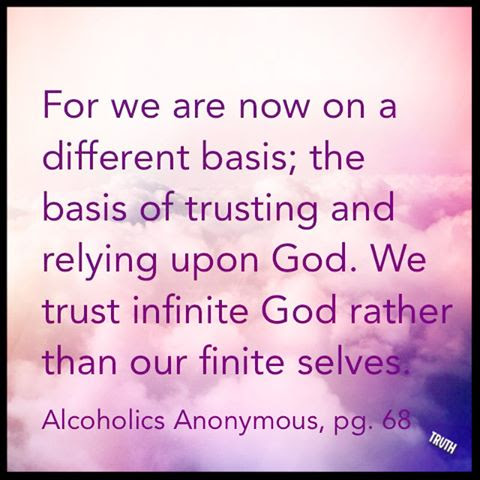
In How It Works, Chapter 5, Bill writes that selfishness was the root of all our problems. Pg 62. And regarding step 3 he wrote “First of all, we had to quit playing God. It didn’t work. Next, we decided that hereafter in this drama of life, God was going to be our Director. He is the principal; we are His agents. He is the Father, and we are His children. Most good ideas are simple, and this concept was the keystone of the new and triumphant arch through which we passed to freedom.” Step 3 is the most important step, is my view.

Step 3 prayer, Pg 63, “God I offer myself to thee, to build with me and do with me as you will. Relieve me of the bondage of self, that I may better do your will…”

Immediately following step 3, comes step 4 and 5. Obviously hugely important. I've sponsored several guys in the past, they've always quit on me during step 4. Doing a full personal inventory is not an easy thing, because it forces us to see the very worst parts of what we've done. Because I know for me, I had a hall of mirrors, smoke and mirrors inside my memory. Where I had rewritten history so that I was the victim and everyone had just done it to me. When I did this 4th and 5th step with Randy I had to clear out the lies, honestly look at the things I’d done, and see the truth. Really the 4th step is all about seeing the truth, telling another person, and by so doing, clearing out the wreckage of the past. All of the terrible things we went through, that we did, all the trauma, the sprees, the jail, the mental hospitals, the treatments, the emotional chaos, broken relationships leaves a pile of debris in our souls. And by doing the 4th and 5th step thoroughly we clear out that wreckage.

I could not stand how I felt while not high or drunk. Being sober was a living nightmare because of this sick mind I have. And all that wreckage in my soul. That was a huge factor that led to me continuing to use, because I felt so terrible sober. The massive, major keystone to surviving in recovery is being humble enough to admit I need to clear that wreckage out. And I can’t leave anything out. The worst stuff needs to come out, or I won’t find healing.

So I did that. It was challenging. My sponsor gave me 3 weeks to write things down. I worked on it and found myself trying to avoid doing it, because it was just rather unpleasant. And I became depressed during that time. But I kept forcing myself to return to the list, and keep writing stuff down. At the end I had 47 pages I think was the total.

Randy and I met one day, in the morning and I went from 8 am until 3pm. We had to meet again the next day, and we went again from 8 am to 1pm. So it took a total of 12 hours to finish doing my fifth step.

Into Action chapter 6 of the big book begins with step 5, then goes into steps 6 and 7. But after step five you’ll notice that there a little list of promises, is what I would call them, which includes pg 75; “We can look the world in the eye. We can be alone at perfect peace and ease. Our fears fall from us. We begin to feel the nearness of our Creator.” See those promises are true. I was so ashamed before I did that step, but now I could look people in the eyes. I would be a nervous wreck by myself, now I can sit at peace. And most importantly of all, all that wreckage in my soul had cut me off from God, and now, for the first time ever in my life, I begin to sense the presence of my Creator. Sensing that presence, is what the program means by “serenity.”

But the big promises, the ones we read at meetings, those promises are from the big book, and they are listed right after step 9. When it says “we will be amazed before we are halfway through” it’s talking about before we are halfway through the 9th step.

Step six is about becoming willing to have God remove our defects of character. So in the fifth column of our 4th step we have our list of character defects. And we look at that list and see which of those kept coming up over and over again. For me selfishness kept coming up. Self-seeking kept coming up. Fear kept coming up. Pride, ego, laziness, being inconsiderate of others, being self-absorbed with my little world. In step 7 I had to ask God to remove those character defects.

The 7th step prayer, which I took with my sponsor said, “My Creator, I am now willing that you should have all of me, good and bad. I pray that you now remove from me every single defect of character…” Pg 76.

Which is interesting, in the Salvation Army, which I work for today, the founder William Booth gave his life to Christ, but later on in his life, in his 30s, he realized one night and wrote in his diary: “God must have all there is of me.” And I realized the same thing. Similarly the 7th step is about turning everything over to God, the good and the bad, and asking Him to change us. Amazing.

I don’t have the power to remove character defects, but God does. But in my relationship with God is I leave the inner work to him, but I do the footwork. So when I see those defects on my list, I try to practice the opposite in my life. If I’m normally fearful, anxious I try to practice courage. If I’m normally selfish, I try to focus on loving and serving others. If I’m normally self-seeking I try to seek God’s will instead. And slowly over the years God removes our defects of character.

Step 8 and 9 were not my favorite steps. But my sponsor asks me to make four lists. He said grab four pieces of paper at the top of each write, first one, right now, next sheet, later, next sheet maybe, last sheet, never. And he had me take my list of people I’d harmed, which I’d made in the 4th step, and write down their names in each of those categories. My mom, my dad, my sister, grandparents, close friends all went on the right now list. But people I didn't want to see, or really still hated, went on maybe or later or never. And he said work on the right now sheet, and by the time your halfway through you’ll want to work on the later sheet, and the maybe sheet, and someday on the never sheet.

Slowly but surely I made those amends, going to the people in person, talking to them. Many people outright refused to even meet with me. To this day, many will never agree to meet with me and listen to my apology. They can’t stand me, they know how manipulative and cunning I can be, so they wont even put themselves in that situation. So be it. I made amends to my grandpa at his grave site, with my dad and grandpa there with me.

And you’ll wonder how do I find these people. I asked myself the same question. But it’s interesting God will cause us to encounter these people. It’ll be our choice if we want to be brave enough to walk up to them and make amends. But I've had that happen time and again, there they are, and I go talk to them.

Step 10 is essentially steps 4 through 9 rolled together, as a daily practice to continue to grow. Step 10 is that we realize that the steps are spiritual tools for daily use, and we keep using them. I do mini 4th and 5th steps all the time, and in prayer I do 7th steps, and I still make amends from time to time. That’s step 10. Step 11 is growing spiritually. So I've got this concept of God. Am I continuing to grow toward God. Am I building that relationship through prayer and study and meditation on his truths. For me that meant attending a good small group, volunteering at my church, getting to church services every Sunday, not just once or twice a week, to really practice my faith.

Step 12 is super important. Now having been taking through the steps by Randy, am I willing to offer this incredible wisdom I’ve received to other alcoholics and addicts? The answer is yes, I am, and I try to carry the message at meetings. And sponsor people. If anyone in this room needs a sponsor, come talk to me, I’m always willing, I’m leaving in 2 months, but I will meet with you. Your part, in that, is mustering the courage to walk up to me, or someone else, and ask. Get active in service work, it’ll change your life. Chapter 7 then, is all about how to do that, how to work with others effectively.

Step 1, I surrendered to the fact that I’m an alcoholic addict, with the two fold malady, of mind and body, it sound simple, it isn’t. I have a mind that fights the disease, telling me I don’t have it, but a final surrender had to be made. Step 2, coming to believe in God, step 3, turning everything over to Him. It’s a radical program of action. Steps 4-9 work through the program of action thoroughly. Step 10, keep that program of action in your back pocket as your tool kit for dealing with life on life's terms. Step 11 continue to grow closer and closer to God (grow, not maintain) and Step 12, share this message with others who need it. Plain and simple, a true way of life for recovery.