
Sunday, March 26, 2023

King Jesus Christ the Lord of the Sabbath


My girlfriend and I went to the dog groomer yesterday, we took her dog Sam in. He was not at all happy when he realized where we were taking him. Sam does not like the groomer, because of the loud noises, and the strange environment. So Sam was shaking as the groomer worked. Sam was uncertain, afraid, but as it went on, the cleaning, the trimming, the washing, the drying, Sam kept his eyes on Chelsey. And when he did that he seemed to calm down just a little bit.

And I thought to myself, we need to learn from that example. As we face problems, stress, difficulties, depression, we should turn our eyes to Jesus our master.  If we do we will find success and relief, and peace, even joy, as we go through the grooming process of God, as he molds us like clay into vessels shaped into the image of Christ.

Last week we saw Jesus the Christ functioning as the Great Physician, miraculously healing those who had been living with debilitating diseases. This was shocking, as Jesus was doing something openly that was in the natural, completely impossible. 

People take notice and the growth of the Jesus movement blows up. No one in human history, has ever been able to heal someone just by touching them. People in Israel begin to realize Jesus is something special in the history of the universe. And they want to know more. We should still want to know more today. Who was this Jesus? Why did he do what he did?

Let’s go boatside as the next steps take place, recorded in Mark’s gospel, in verses 13-14:

“Once again Jesus went out beside the lake. A large crowd came to him, and he began to teach them. As he walked along, he saw Levi son of Alphaeus sitting at the tax collector’s booth. “Follow me,” Jesus told him, and Levi got up and followed him.”

Tax collectors were Jews who were working for the enemies of Israel. Israel had been conquered by Rome. And Rome recruited Jews to work for them, and they’d pay them well, and often the tax collectors would also take extra in taxes for themselves.

Tax collectors were hated. They were seen as traitors working for a foreign government. Like if you found out your neighbor was an informer for the nation of Iran, or the communist republic of China, or the Russian federation.

But Jesus again and again cut right threw those dividing lines in society. It would be like if you were with Jesus, and you saw him walk into a drug house or a bar, and call a drug dealer or a bartender to follow him.

I’m sure his disciples were shocked to see Levi joining them. But then again, Jesus had already called Mary Magdalene who had been a working woman, a prostitute.

But that’s how it is with following messiah Jesus. He doesn’t see those distinctions. He sees the heart. He sees that Levi is ready, broken, miserable, and he’s reached a point in his heart, where he is ready to give his entire life to serving the kingdom of God.

Jesus met each of us at that point in our lives. It was the point when we were finally ready to start following Him. Not everyone is at that point. Which is why when we talk to people, and invite people to church, often they aren’t ready yet. But hopefully we can be a link on that chain, as others witness to them, and pray for them. Then one day, God willing, they will reach that point when they can give it all over to Jesus Christ.

Levi is called to new service, after serving Rome all those years, now he will finally serve God. You are called to serve God too.

Later we see Jesus eating a meal with sinners. It says this in verses 15-17:

“While Jesus was having dinner at Levi’s house, many tax collectors and sinners were eating with him and his disciples, for there were many who followed him. When the teachers of the law who were Pharisees saw him eating with the sinners and tax collectors, they asked his disciples: “Why does he eat with tax collectors and sinners?”

On hearing this, Jesus said to them, “It is not the healthy who need a doctor, but the sick. I have not come to call the righteous, but sinners.”

For Levi (aka Matthew) now is the time. Now is the time for hope. Now is the time to do the work of ministry. The same is true for Jesus. He’s waited his whole life for this moment.

Now is the time, and Jesus is hard at work, sitting and eating and talking with sinners. He’s with the worst of the worst. That should be our philosophy as well as Christians, I should be connecting with and befriending those that society has neglected. I should be talking with people who can give me nothing in return. I should be talking with people who are considered to be less than important. 

We’re cautious about that. We don’t put ourselves in dangerous or compromising situations. We guard against falling into sin ourselves. But Jesus called people who were broken, burned out, and lost in sin. He found them where they were. He changed them and they followed Him.

We do the same. And we see people’s lives change as a result, as we tell them about Jesus, bring them to church, read the Bible with them, and help them along in their journey with Christ.

If they aren’t ready yet. We make the offer. Maybe they go the other direction. That’s ok. We did our part. We keep spreading the message to new people. Maybe they will come around later when they’re ready. Maybe not. We will see.

So you have Jesus Christ traveling around with his disciples, eating and drinking with sinners and tax collectors. You also have John the Baptist in the wilderness, calling people to repentance from their sins. Then you have the Pharisees and the Sadducees, enforcing the old testament law of Moses, trying to make sure Israel honors God through the law.

Fasting was a common spiritual practice. Many practiced it. John's disciples fasted. The Pharisees and Sadducees fasted. So Jesus encounters a question from the Pharisees. It says in verse 18-20:

“Now John’s disciples and the Pharisees were fasting. Some people came and asked Jesus, “How is it that John’s disciples and the disciples of the Pharisees are fasting, but yours are not?”

Jesus answered, “How can the guests of the bridegroom fast while he is with them? They cannot, so long as they have him with them. But the time will come when the bridegroom will be taken from them, and on that day they will fast.”

Again, Jesus says, now is the time. A new day has come.

I believe, in 2020, a change took place in the world. I believe the world is beginning to slowly come apart, as we move toward the end times, but I believe that this collapse will coincide with a great awakening, a great revival, where millions and millions will turn to Christ.

Now is the time. Not later, now. It's the same with Jesus in this situation. Can his disciples fast, not eat, cover themselves in ashes, while Jesus is still with them? Certainly not. They are celebrating, they are excited, they are at work. But Jesus says later, after he departs, then they will fast. Which is why we fast today, in the body of Christ. Jesus is not physically with us. The Holy Spirit is with us. But Jesus will come again. Until that time, we fast, we pray, we work.

Now is the time to evangelize. If you feel the Holy Spirit convicting you to go tell someone Jesus loves you, then go do it now. Now, not later. And if we know the good we’re supposed to do and we refuse to do it, that is sin to us. Fear God, take a deep breath, and go share the gospel with love with that person. Now is the time.

Mark includes one of Jesus’ gospels next, it says: (verses 21-22)

“No one sews a patch of unshrunk cloth on an old garment. Otherwise, the new piece will pull away from the old, making the tear worse. And no one pours new wine into old wineskins. Otherwise, the wine will burst the skins, and both the wine and the wineskins will be ruined. No, they pour new wine into new wineskins.”

I don’t want to get too deep into the parable at this point. Suffice to say, Jesus is the new cloth, the new wine, the new way, the true way, and can’t be forced into old patterns or mindsets.

We have a new way before us. The world has changed. And we need to embrace a new pattern. A new level of interaction. New spiritual gifts. New power. God is moving. It’s not like the old ways, we’re entering a new season. Every season is different. We have to be ready for what God is doing. 

Pray and ask God to equip you with every spiritual gift and all the spiritual power you need for this new season. 

First was the calling of Levi and the meal after, second, the question about fasting, and third, the incident in the grainfields.

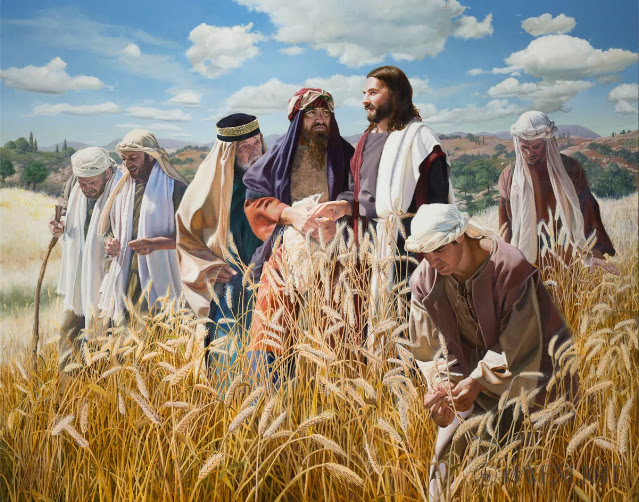
In verses 23- 28: One Sabbath Jesus was going through the grainfields, and as his disciples walked along, they began to pick some heads of grain. The Pharisees said to him, “Look, why are they doing what is unlawful on the Sabbath?”

He answered, “Have you never read what David did when he and his companions were hungry and in need? In the days of Abiathar the high priest, he entered the house of God and ate the consecrated bread, which is lawful only for priests to eat. And he also gave some to his companions.”

Then he said to them, “The Sabbath was made for man, not man for the Sabbath. So the Son of Man is Lord even of the Sabbath.”

The disciples are walking through grain fields. A common practice according to the Old Testament law, was for farmers to leave some of their crop left over for the poor. Kind of like having a food pantry. You set aside some for people in need. And Jesus’ disciples are plucking heads of grain and eating them, in accordance with this practice. 

The Pharisees see this and they are shocked. The Pharisees were very strict about sabbath observance. On Saturdays you did no work. That’s still true today for orthodox Jews, if you meet them. They will not do any work on Saturdays. They will even set elevators to stop automatically at each floor on the sabbath. Why? Because pushing the button would be work.

But Jesus says that isn’t the right way. The sabbath was given by God for man to enjoy restful fellowship with God. The disciples are practicing proper sabbath, they are spending time with God, with Jesus Christ himself. But the Pharisees rebuke them.

Jesus reminds them of David and the priest who gave David the bread of the presence, even though it wasn’t normally bread you’d give to just anyone. And Jesus concludes by saying, the Son of Man is Lord of the sabbath as well.

Today, for our final point, we are called to serve the King of the sabbath, the king of this city, the king of this country, the king of the universe, and he is Lord of all. He does call us to sabbath rest. Yet he is also Lord even of the sabbath. So we should rest on the sabbath. But that rest is a gift, not a burden. 

We are called now to serve a King who has authority over us. Total authority. And he’s given us all we need for life and godliness from his riches of power and authority. God has gifted us with everything we need to live the Christian life successfully. He is Lord. Over everything. And we’re His. That means we just need to be bold, faithful, and loving, and we’re going to have victory. And Jesus is going to find us to be a grain field, a harvest of righteousness, bringing many people to glory with us. That is our goal.

Jesu is at work in Mark 2, and people are getting saved, people are changing, lives are changing, and he is asserting total authority in his teaching. And people either come into alignment with the authority of Christ, or they fight against him. Let's be people today who come into total alignment with the purposes of God. 

No in-between! Let's strive for total commitment, total submission, total alignment. Entire sanctification. Complete transformation. Crucified with Christ. Born again. New man. New woman. Completely yielded to King Jesus Christ, the undisputed leader and representative of humanity, now and always. Make that your goal in life. Total submission, complete love, all in, on fire for Christ! Imagine what you’ll accomplish in Jesus name!
Sunday, March 19, 2023

Abigail calms the wrath of David


In chapter 25 of 1st Samuel we see several turning points in the life of David. Many years ago David had been a young shepherd boy when he met a prophet of Israel named Samuel. But the story is about to shift radically.

It says in 1st Samuel 25:1: “Now Samuel died, and all Israel assembled and mourned for him; and they buried him at his home in Ramah. Then David moved down into the Desert of Paran.”

The prophet of God has now died. And David moves his men into the desert.

Samuel never saw David take the throne. He waited all those years, watching Saul squander everything. But Samuel believed. Even though he never saw it happen. He knew David would be king. I’m sure David mourned the loss, I wonder if he even attended the funeral in secret, watching with tearful eyes as they entombed Samuel the prophet of God.

David headed off into the desert I’m sure with a heavy heart mourning the loss, but the next phase of his journey was about to begin.

That's our first point for today: Be aware of turning points in your life. I've noticed this about God, he will give nudges that a turning point is near. A big shift happens, and the journey changes from one stage to the next. It's almost like leveling up in an RPG video game, your traits are adjusted, you've gained new skills, and you move forward to a new spiritual region. 

Next, we’re going to see an incident that occurs between David and a man named Nabal.

The scriptures say, 1st Samuel 25:2-3, “2 A certain man in Maon, who had property there at Carmel, was very wealthy. He had a thousand goats and three thousand sheep, which he was shearing in Carmel. 3 His name was Nabal and his wife’s name was Abigail. She was an intelligent and beautiful woman, but her husband was surly and mean in his dealings—he was a Calebite.”

Nabal and Abigail, Nabal is a mean guy, negative, harsh. We’ve all known men like that, gruff, intense, loud, sharp, mean-spirited, and just want to yell at you. But he’s married to this beautiful, intelligent woman named Abigail.

Nabal means “fool” it could’ve been a nickname, though perhaps by a twist a fate it was his actual given name. But he seems to fit the name well. He’s stubborn and doesn’t listen, as we’ll see in a moment.

David has been a help to Nabal in the past, it says in verse 4-6, “While David was in the wilderness, he heard that Nabal was shearing sheep. So he sent ten young men and said to them, “Go up to Nabal at Carmel and greet him in my name. Say to him: ‘Long life to you! Good health to you and your household! And good health to all that is yours!”

David orders his men to be very polite and respectful to Nabal in seeking his help. He sends messengers to connect with Nabal, to start things off on the right foot.

The message continues, verse 7-9: "Now I hear that it is sheep-shearing time. When your shepherds were with us, we did not mistreat them, and the whole time they were at Carmel nothing of theirs was missing. 8 Ask your own servants and they will tell you. Therefore be favorable toward my men, since we come at a festive time. Please give your servants and your son David whatever you can find for them.’” When David’s men arrived, they gave Nabal this message in David’s name. Then they waited.”

So David is looking for some supplies, some provisions, food, clothing, water, whatever Nabal can spare.

Let’s see Nabal’s response, verses 10-11:

Nabal answered David’s servants, “Who is this David? Who is this son of Jesse? Many servants are breaking away from their masters these days. Why should I take my bread and water, and the meat I have slaughtered for my shearers, and give it to men coming from who knows where?”

Nabal’s response is harsh, rude, he says, "who are you? I don’t know who you are. Many people are rebelling against their masters today, and why should I give my food and drink to random people anyway?" A very worldly response. I’m not helping anyone, what’s mine is mine and that’s all. If Nabal was wise, he would know, this is the coming king of Israel, if I help him, he will show me favor in the future. But Nabal is a fool, so he makes some smart remarks. He insults David and his men, and sends them away with nothing.

Let’s see what happened next. Verses 12-13, “David’s men turned around and went back. When they arrived, they reported every word. David said to his men, “Each of you strap on your sword!” So they did, and David strapped his on as well. About four hundred men went up with David, while two hundred stayed with the supplies.”

So here we see David is angry with Nabal’s response. He gathers his men, 400 of the 600, weapons ready, to go and deal with Nabal.

Our second point today is this: Watch your words carefully. Watch your tone of voice, in your dealings with people. You can make enemies very quickly by what you say. And by how you say it. Check your harsh words. Wait a minute before you speak. Be cautious how you speak. Your words have power. And be careful what you post on social media. Make sure it’s edifying, valuable, holy, good. Because your words can often come back to bite you, just like in this situation. 

Time and again in the book of Proverbs, it talks about watching your words, using wise words, and giving a timely word. Remember that our words have power. Use your voice wisely. 

Meanwhile the employees of Nabal saw how he mistreated David’s men. It says in verse 14-17: “One of the servants told Abigail, Nabal’s wife, “David sent messengers from the wilderness to give our master his greetings, but he hurled insults at them. Yet these men were very good to us. They did not mistreat us, and the whole time we were out in the fields near them nothing was missing. Night and day they were a wall around us the whole time we were herding our sheep near them. Now think it over and see what you can do, because disaster is hanging over our master and his whole household. He is such a wicked man that no one can talk to him.”

David’s men had apparently been protecting the flocks and employees of Nabal when they were in his region. And they never stole anything, or took anything for themselves. But Nabal has insulted David. And the servant can tell something bad is coming.

Have you ever been in a situation where you can sense that something is wrong? Fire is burning. Get out of the building. And you must act quickly! Critical moments are taking place. It’s moving fast. And we’ve got to act. I've had times like that in my life, I knew, I need to act quickly. 

Disaster is hanging over their heads. Let’s see what Abigail does next in verses 18-19:

“Abigail acted quickly. She took two hundred loaves of bread, two skins of wine, five dressed sheep, five seahs of roasted grain, a hundred cakes of raisins and two hundred cakes of pressed figs, and loaded them on donkeys. Then she told her servants, “Go on ahead; I’ll follow you.” But she did not tell her husband Nabal.”

Abigail springs into action. She’s going to somehow make things right with David and his men. She must know they’ll certainly be coming soon. So she heads in their direction on a donkey. She doesn’t come empty handed though, she brings huge amounts of food and drink. She’s coming with gifts. She’s a wise, godly, beautiful woman who is going to somehow make this right. I’m sure this isn’t the first time she’s had to deal with blowback from Nabal’s foolish behavior.

That’s our third point today, know when you need to spring into action. Take the required action. Step up in faith. And do so with wisdom. If you’ve got to settle a dispute, bring a gift along with you. It can help cool off the raging anger of those you’re trying to reach.

Same with us today, if we’re in sin, if we’ve wronged someone, we must spring into action, in Spirit and in truth, to turn away the wrath, to seek forgiveness and to find right standing once again. Abigail goes to work to make this right. 

Sometimes God will tell us to "Stand still" and watch as He works. Other times he'll tell us "get up and go" and get to work. That's why we have to be wise and discern what God is saying to do in our situation. Sometimes it's "stand still" other times it's "go and take action." 

Abigail heads out. In verses 20-30:

As she came riding her donkey into a mountain ravine, there were David and his men descending toward her, and she met them. David had just said, “It’s been useless—all my watching over this fellow’s property in the wilderness so that nothing of his was missing. He has paid me back evil for good. May God deal with David, be it ever so severely, if by morning I leave alive one male of all who belong to him!”

When Abigail saw David, she quickly got off her donkey and bowed down before David with her face to the ground. She fell at his feet and said: “Pardon your servant, my lord, and let me speak to you; hear what your servant has to say. Please pay no attention, my lord, to that wicked man Nabal. He is just like his name—his name means Fool, and folly goes with him. And as for me, your servant, I did not see the men my lord sent. And now, my lord, as surely as the Lord your God lives and as you live, since the Lord has kept you from bloodshed and from avenging yourself with your own hands, may your enemies and all who are intent on harming my lord be like Nabal. And let this gift, which your servant has brought to my lord, be given to the men who follow you.

“Please forgive your servant’s presumption. The Lord your God will certainly make a lasting dynasty for my lord, because you fight the Lord’s battles, and no wrongdoing will be found in you as long as you live. Even though someone is pursuing you to take your life, the life of my lord will be bound securely in the bundle of the living by the Lord your God, but the lives of your enemies he will hurl away as from the pocket of a sling. When the Lord has fulfilled for my lord every good thing he promised concerning him and has appointed him ruler over Israel, 31 my lord will not have on his conscience the staggering burden of needless bloodshed or of having avenged himself. And when the Lord your God has brought my lord success, remember your servant.”

Abigail’s gracious and humble words turn back David’s wrath. Abigail speaks truth, speaks life over David. She says what Nabal should’ve said. Her words are matched by the food and drink she brings as well. She humbly asks for mercy from David and his men.

Fourth point today, speak gracious words. Be humble. And you’ll find success. If you’re prideful or harsh, obviously it’s not going to turn out like this. But if you humble yourself, speak gracious words, and speak life, you’ll find reconciliation.

How does David respond? In verse 32-35 it says:

David said to Abigail, “Praise be to the Lord, the God of Israel, who has sent you today to meet me. May you be blessed for your good judgment and for keeping me from bloodshed this day and from avenging myself with my own hands. Otherwise, as surely as the Lord, the God of Israel, lives, who has kept me from harming you, if you had not come quickly to meet me, not one male belonging to Nabal would have been left alive by daybreak.”

Then David accepted from her hand what she had brought him and said, “Go home in peace. I have heard your words and granted your request.”

Point number five, David gives God the glory. Abigail did all the right things here. But it was ultimately God who gave the victory. Guess what, you can do all the right things, say all the right things, and it can still turn out bad. But, in this situation, God moves in David’s heart to have mercy on Abigail and her family.

Next, Abigail goes back to her husband to tell him what happened. In verses 36-39:

When Abigail went to Nabal, he was in the house holding a banquet like that of a king. He was in high spirits and very drunk. So she told him nothing at all until daybreak. Then in the morning, when Nabal was sober, his wife told him all these things, and his heart failed him and he became like a stone. About ten days later, the Lord struck Nabal and he died. 

When David heard that Nabal was dead, he said, “Praise be to the Lord, who has upheld my cause against Nabal for treating me with contempt. He has kept his servant from doing wrong and has brought Nabal’s wrongdoing down on his own head.”

Point number six, let God deal with your enemies. It’s not your job to deal with them. Since David left it to God, God dealt with Nabal quickly. And Nabal was struck by God and died.

The only problem now is Abigail doesn’t have a husband. Her foolish husband Nabal has been struck dead. In ancient times men were the landowners, women had to have a husband to be cared for. 

So, it says in verse 39-44: Then David sent word to Abigail, asking her to become his wife. His servants went to Carmel and said to Abigail, “David has sent us to you to take you to become his wife.”

She bowed down with her face to the ground and said, “I am your servant and am ready to serve you and wash the feet of my lord’s servants.” Abigail quickly got on a donkey and, attended by her five female servants, went with David’s messengers and became his wife. David had also married Ahinoam of Jezreel, and they both were his wives. But Saul had given his daughter Michal, David’s wife, to Paltiel son of Laish, who was from Gallim.”

Abigail goes from being saddled with Nabal, always having troubles, to taking a new course of action, and she now joins up with David’s army. She becomes his wife, and a blessing to his troops and men. She becomes an honored woman in his affairs.

Point seven today, God provides for those he loves. He provided two ways here, first, by providing the food and drink for David’s men through Abigail’s offering, and providing marriage for David and Abigail. God provides marriage to David, romance to David, through Abigail becoming his wife. I’m sure David was lonely as this leader in exile, with his fighting men in the wilderness, so God provides companionship through Abigail. Abigail is also now cared for, and not left alone to beg on the streets. God is our provider.

So how can we apply what we learned today from Abigail and David's conduct? Let's review our seven points: 

Point number one, be aware of turning points in your life, like the death of Samuel, it marked a turning point in the history of Israel, and in David’s life.

Point number two, watch your words, tone of voice, a gentle answer is wise, a harsh answer brings offense.

Point number three, jump into action when the moment calls for it. (Know when to stand still as well) 

Point number four, speak humble gracious words to turn away offense. Use wisdom.

Point number five, give God all the glory, he guides events, not our wisdom.

Point number six, let God deal with your enemies, he certainly will.

Point number seven, God provides for those he loves. Twofold in David's situation: food and drink, and romance/marriage.

A Rock Solid Faith in the God of the Impossible


I remember growing up there were always students at school who were excluded. Some of them were excluded because they were different, they were handicapped, and others were excluded because they were considered different, were considered “losers” and sat at the “loser table.”

What does it feel like to be different? What does it feel like to be excluded? It feels pretty painful. It feels isolating. It makes you wonder, “Is there something wrong with me?”

To my shame, I was at times one of the students who made fun of those who were different. I’m sure some of us did the same when we were kids. At other times, we were the one who reached out to the ones who were different, and helped make them feel welcome.

I made fun of a kid who was in a wheelchair when I was in 7th grade. I was also bullied by other students, shoved, punched, and so on. But I had done it too. And had it done to me.

Then there was a time a new student came to our school and I made him feel welcome. And as Christians we want to be those who make people who are excluded feel loved and welcome. We want to help them find a place in our community.

This was Jesus’ attitude as well. And as followers of Jesus, we want to emulate his activity.

It’s recorded that in Mark chapter one a man with leprosy came to ask Jesus for help. Leprosy still exists in the world today, even in certain parts of the USA, it's a type of bacteria though that is treatable today. But in ancient times, lepers were excluded from society.

People were afraid to come near them. If they came into the cities they would often be driven out. Most lepers simply had to stay at a distance from people, and beg for food and money. But a man with leprosy had heard about this God-man Jesus, this savior, and had come to him with hope.

It says in Mark 1:40, “A man with leprosy came to him and begged him on his knees, “If you are willing, you can make me clean.”

1. Hope
Here we find our first point for today: Come to Jesus time and again with hope that he can help you.

That is what we did when we first believed on Jesus Christ for our salvation. We came to Jesus believing that he could help us.

And we need to keep coming to Jesus, as we struggle, as we battle sin in our lives and remove it, and come to Jesus, believing, hoping, that he can deliver us.

Sometimes we get stuck in a status quo. Well, Jesus washed away my sins, but he can’t help my lying problem. Jesus washed away my sins, but he can’t help my gambling problem. Jesus can’t help my stealing problem, or my selfishness. But that’s not true. If Jesus can wash away your sins, he can deliver you from any sin in your life.

Continue to come to Jesus with a hope, maybe this can change! Continue to come to Jesus with faith. Maybe that’s why we struggle today we aren’t coming in faith. We’ve surrendered to the sin, or the sorrow, or the depression, but it’s time to take hope again, and believe Jesus can help you. Now. Ask now, for Jesus to give you a new hope and a new faith.

What if this guy with leprosy never came to Jesus? He just said well, I’ve leprosy my whole life, so he can’t help me. I just won’t even come. But that’s not what happened. He came and found Jesus knowing, believing, hoping, maybe Jesus can help me.

Let’s see what happens next:

In verses 41-42: “Jesus was indignant. He reached out his hand and touched the man. “I am willing,” he said. “Be clean!” 42 Immediately the leprosy left him and he was cleansed.”

The NIV translation renders verse 41 as “Jesus was indignant” but most other translations render it as “Jesus had compassion on him.”

But maybe it was a mixture of the two? Jesus was indignant means Jesus was angry and disturbed and upset by this man’s condition. I’m sure that’s true. When we see someone who is suffering terribly, our first reaction is often anger, we’re upset, how can this be! It’s not right!

Often at that same moment as we’re indignant we’re also filled with compassion. We have compassion on that person.

2. Compassion
That’s our second point today, as Christians our response to suffering should be compassion. What is compassion?

It’s like we enter into their situation and have a sense of pity, a sense of wanting to help, a sense of love mixed with desire for action. We get involved in the situation.

That is one of our chief jobs as Christians, we feel compassion for hurting people and that compassion causes us to take action.

But I think sometimes we worry, when we come to Jesus with a sin or a problem or anxiety or depression, is Jesus really willing to help us? The answer is almost always yes. Plain and simple. Rarely I think it is no. We may bring a chronic health problem or a mental health problem to Jesus and he may say no, I’m not going to heal you, you’re going to glorify God by dealing with this problem. But if it’s a sin you’re bringing to Jesus, the answer is always yes. There may be footwork on your part though to be free.

You may need to go to a counselor, or attend a 12 step group, or go through a book or workbook on the sin, or you may need to feel the sorrow of the sin for a while until you’re finally willing to repent from the heart. But Jesus is willing to help us in all that process.

He is a God of indignation, evil upsets Him. And when God sees evil, he also has compassion on the one who is struggling and seeks to help them.

Next, in verses 43-45: “Jesus sent him away at once with a strong warning: 44 “See that you don’t tell this to anyone. But go, show yourself to the priest and offer the sacrifices that Moses commanded for your cleansing, as a testimony to them.” 45 Instead he went out and began to talk freely, spreading the news. As a result, Jesus could no longer enter a town openly but stayed outside in lonely places. Yet the people still came to him from everywhere.”

The Lord gives this man a strong warning, don’t tell anyone, because if he tells people it’s going to upset his timing. He tells the man, go to the priests. And it’s going to be a testimony to them, that God is doing something, healing lepers, that they would then believe. But the man does not obey Jesus, instead he starts telling everyone about what happened. The result is Jesus can’t go near the cities, instead he has to go off into hiding.

3. Trust
So third point for today, listening to God, obeying Him is important. Even when we don’t really understand why. Sometimes God has asked me to do something and I don’t understand why, so I don’t do it. And often I see later why God wanted me to do it that way. But I didn’t listen.

Similarly in 12 step groups, often times the person will not take the 12 steps to get better, because they don’t understand why it would help them. So they refuse to do it. Because they don’t understand it.

But if they would just trust the process and do it anyway, they’d see the results.

I always remind all of you to pray in the morning, pray at night, read your Bible, read a psalm, read a chapter of proverbs, read a chapter from the new testament everyday.

Many of you I think, don’t understand why you should do that, so you don’t do it. And as a result your spirituality is weak and you’re always struggling and unable to keep your faith strong at all. But if you would just listen, and do it, even if you don’t understand why, later you’d see, how strong your faith would become, and how you would be much more stable in all your life, if you just listened.

But sometimes we don’t want to listen, because we don’t understand. Or maybe we’re just lazy. In any case, this cleansed man, doesn’t listen to Jesus either. And it upsets the timing of his ministry, where Jesus has to go off into the wild. But still, God’s plan moves forward, as people come out to see him there.

Obey God, even when you don’t understand, trust Him, even when you don’t see all the details. He is trustworthy. Even when we don’t understand. Do what he says anyway. And watch your life be transformed. But if you don’t want anything to change in your life, just keep doing it the same way you always do. And its going to be a mess. But, what if, what if you really did listen to God, do what he says, how would you life be transformed?

For the next few days Jesus is out in the wilderness. But then he heads home.

From Mark 2:1-3 “A few days later, when Jesus again entered Capernaum, the people heard that he had come home. 2 They gathered in such large numbers that there was no room left, not even outside the door, and he preached the word to them. 3 Some men came, bringing to him a paralyzed man, carried by four of them.”

4. Hope for another
Point number one, becomes active for others, we’ve received grace from Jesus Christ, now we want others to find that same grace from Jesus Christ, we start to have hope for others. We start to believe others can have faith too. That is hope for our friends and neighbors, and even strangers, people we don’t know.

Next in verses 4-5, “4 Since they could not get him to Jesus because of the crowd, they made an opening in the roof above Jesus by digging through it and then lowered the mat the man was lying on. 5 When Jesus saw their faith, he said to the paralyzed man, “Son, your sins are forgiven.”

5. Compassion for another
Point number two becomes active through us, to others, compassion for others. Compassion moves us to action. Action for these people is to dig a hole in the roof, and drop their friend down in to it, so their friend can meet Jesus. That is true compassion in action!

Now skip forward to verses 11 and 12, “So he said to the man, 11 “I tell you, get up, take your mat and go home.” 12 He got up, took his mat and walked out in full view of them all. This amazed everyone and they praised God, saying, “We have never seen anything like this!” -Mark 2:11-12

6. Trust for another produces Trust
Faith is the key in this whole situation. They believe. Their friend believes. This means action in love. Trusting in Jesus, leads these friends to bring their friend to Jesus. The result is their friend trusts Jesus too. His sins are forgiven. And Jesus heals him. He takes his mat and walks home. And the result is, everyone around sees this and praises God. Glory is given to God through all this.

The people learn faith as well. They see something amazing happen, this leads them to believe and trust that Jesus really is God.

That’s point number 6, linked to point 3, Trust in God leads to others learning to trust in God too.

Point 1, hope links to point 4, hope for others.

Point 2, compassion links to point 5, compassionate action for others

Point 3, trust/faith links to point 6, others learning to trust through you

Now, to pull it all together, let’s look at verse 6 through 10, which is happens just before the man is healed:

“Now some teachers of the law were sitting there, thinking to themselves, 7 “Why does this fellow talk like that? He’s blaspheming! Who can forgive sins but God alone?”

8 Immediately Jesus knew in his spirit that this was what they were thinking in their hearts, and he said to them, “Why are you thinking these things? 9 Which is easier: to say to this paralyzed man, ‘Your sins are forgiven,’ or to say, ‘Get up, take your mat and walk’? 10 But I want you to know that the Son of Man has authority on earth to forgive sins.” -Mark 2:6-10

7. Evidence of Christ leads to Trust in Christ  
Why is Jesus healing people? Why is he doing these miraculous things that no one has ever done before in the history of human kind? That’s one of the reasons we remember him. That’s one of the reasons we believe in Him today. We hear about Christians being healed, people being healed after Christians pray for them. It’s real. But why? Why does he do this? Yes, because he loves us. But there is a great purpose behind it all: He is proving to the people of Israel, and indeed to the entire world: I am really God in human form.

Jesus Christ of Nazareth, was saying through these miracles: I am who I am. I really am God on Earth. Which is why the Pharisee has no ground to stand on as far as his complaint goes. Jesus answers his thoughts, which how could Jesus answer someone's thoughts, either, but Jesus says, anyone could say “your sins are forgiven.” Words are one thing. But, look at the signs I perform. Look that this paralyzed man can now walk.

Which is easier to say your sins are forgiven, or to say, get up and walk? It’s much easier to say your sins are forgiven. It’s much harder to tell a paralyzed man to get up and walk. But then it happens. And for that reason, this paralyzed man getting up, the Pharisee should be able to say, well, if the voice of Jesus says get up and walk and it happens, then it must also be true, that when Jesus says “your sins are forgiven” that is also 100% true. Just as true as the miracle he just performed. By speaking.

Faith + Evidence of Christ = Salvation 

So if we’re told we must come to Jesus Christ for eternal life, for forgiveness of sins, we can believe that this is 100% true, because of what Jesus has already done, in the life of the leper, in the life of the paralyzed man, in the lives of billions of people today on planet earth, and in the lives of our family members, our parents, our grandparents, our great-grandparents, all the way into the past, yes, it’s real, and we can, indeed, we must believe it.

And oh what danger we are in if we refuse Him who call us to Himself. We must come. Or we can only blame ourselves for what happens if we don’t.

Once we were the bullies, in some form or another, we were the sinners. We were evangelists of sin you could say, we lived in sin and we taught others to sin by our actions and lifestyle.

Like the story at the beginning, I used to bully other students at times, I was also bullied, part of the system you could say.

Now we become a glitch in the system, we resist the system, we change the system. Now instead of bullying, instead of spreading sin, we spread truth. We compassionately love others. We protect the bullied. We reach out and love others. We bring others to Jesus. Make that your mission for life, bring others to Jesus. That should be your lifestyle now. Don’t be an evangelist of sin anymore, be an evangelist of Christ!

Saturday, March 18, 2023

Nursing Home Devotional


I’d like to share with you today a parable that Jesus taught during his ministry, called the parable of the talents.

From Matthew chapter 25, verses 14-30.

The scripture says this: “Again, the Kingdom of Heaven can be illustrated by the story of a man going on a long trip. He called together his servants and entrusted his money to them while he was gone. 15 He gave five bags of silver to one, two bags of silver to another, and one bag of silver to the last—dividing it in proportion to their abilities. He then left on his trip.”

Then it says, “The servant who received the five bags of silver began to invest the money and earned five more. 17 The servant with two bags of silver also went to work and earned two more. 18 But the servant who received the one bag of silver dug a hole in the ground and hid the master’s money."

So the three servants make their various choices with the money they’ve been entrusted with, the first earned five more, the second two more, and the third hid the money.

It continues, “After a long time their master returned from his trip and called them to give an account of how they had used his money. 20 The servant to whom he had entrusted the five bags of silver came forward with five more and said, ‘Master, you gave me five bags of silver to invest, and I have earned five more.’

21 “The master was full of praise. ‘Well done, my good and faithful servant. You have been faithful in handling this small amount, so now I will give you many more responsibilities. Let’s celebrate together!

22 “The servant who had received the two bags of silver came forward and said, ‘Master, you gave me two bags of silver to invest, and I have earned two more.’

23 “The master said, ‘Well done, my good and faithful servant. You have been faithful in handling this small amount, so now I will give you many more responsibilities. Let’s celebrate together!’

The master is gone a long time. Then, he finally returns, the moment we’re all waiting for. This is the moment I’m building my life for. I hope you are too. The moment when either you die of old age, or Jesus returns, whichever comes first, and we stand before God to explain our lives.

For the first two servants, this day is everything they could’ve hoped for. They received the money they were given, and made use of it in the world, and brought a return to their master.

They are returning double, they were given 2 talents, they returned 4 talents, they were given 5, they return 10.

It’s interesting though in Mark 4:20 in the parable of the soil, it says, "And the seed that fell on good soil represents those who hear and accept God’s word and produce a harvest of thirty, sixty, or even a hundred times as much as had been planted!””

Our harvest can be very plentiful indeed!

How does the master respond to the servants who have completed their mission? He says to them “well done good and faithful servant.”

The master continues and says, because you’ve been trustworthy in a little, I’ll put you in charge over much.

In fact in this parable in Luke, it says in verse 17, “17 “‘Well done!’ the king exclaimed. ‘You are a good servant. You have been faithful with the little I entrusted to you, so you will be governor of ten cities as your reward.’ And for the second servant he says, you will be governor over five cities. That is a massive reward. From working with money and investing it, to being in charge of entire kingdoms. That is a huge gift.

It's a great reminder that Christ is watching to see how we’re trustworthy with the little we have in this life.

Alright we’re done, right? Everyone goes to heaven right? Everyone does the right thing.

No, the parable doesn’t end there. There’s a third servant, let’s see what happens next.

“Then the servant with the one bag of silver came and said, ‘Master, I knew you were a harsh man, harvesting crops you didn’t plant and gathering crops you didn’t cultivate. 25 I was afraid I would lose your money, so I hid it in the earth. Look, here is your money back.’

The servant actually insults his master, calling him harsh, and basically insinuating that he didn’t do any of the work himself so why should he get the harvest kind of thing. Nasty, rude response. So he didn’t do anything with the money, he hid it underground and gave it back later.

26 “But the master replied, ‘You wicked and lazy servant! If you knew I harvested crops I didn’t plant and gathered crops I didn’t cultivate, 27 why didn’t you deposit my money in the bank? At least I could have gotten some interest on it.’

28 “Then he ordered, ‘Take the money from this servant, and give it to the one with the ten bags of silver. 29 To those who use well what they are given, even more will be given, and they will have an abundance. But from those who do nothing, even what little they have will be taken away. 30 Now throw this useless servant into outer darkness, where there will be weeping and gnashing of teeth.’
-Matthew 25:26–30

I think there is a temptation to take what Jesus has given us, our time, our talents, our abilities, our wealth, and to hide it away. We’re afraid we wont do a good job, that we’ll play off key, that we won’t do it right, that we’ll fail, so we just don’t do anything at all with it. We’re afraid to, of God, and of how he’ll view our work. So we just hide it away and don’t use it.

And for that servant they are called wicked and lazy. The opposite of good and faithful. Instead of good, wicked. Instead of faithful, lazy. Good to know the opposite so we can avoid it.

There will be accountability for those who fail to serve Christ in this life. If we reject his calls to service, if we don’t use the gifts he’s given us, we’ll be held accountable.

And if we do use those gifts and talents for His glory, we will be rewarded. It even says, that the master says, let’s celebrate, he’s so happy, he throws a party for them, because they did well, he says let’s celebrate.

Time to celebrate. Time for perfect existence. Time for a garden perpetual. A garden unending. A peace that never ends. Time to wander the streets of gold, the valleys of golden wheat, the blue mountains, the endless houses, and parties and get togethers and worship times, the moments so balmy they seem like euphoric dreams. The joy and contentment so sweet, sweeter than any dessert, magic nights in the city of God, talking on porches, running and playing with animals, flying through the sky to view the beauty, seeing the infinite God taller than a skyscraper, parts of him moving in and out and shifting and spinning wheels and creatures and angels crying out, and a rainbow, and a sea of glass shifting in the air, glowing stones, lightning and thunder, clouds, and glory, everyday, perfect life, perfect joy, no more controversy, no more rebellion, no more sin.

Well done good and faithful servant. You don’t need me to tell you about talents you know what yours are, use them build for that future which is more real than this life, more real than anything in this world, is that future. Make sure you spend your eternity there build now for there. Amen.